
IELTS Calculator with Scoring Chart and University Eligibility
Calculate your IELTS band score using the official scoring system, learn how Listening, Reading, Writing, and Speaking are assessed, and check your university eligibility based on your results.
IELTS Listening band score calculator
Number of correct answers ( 0 - 40 )
🎧
/40
--
Listening
IELTS Reading band score calculator
Number of correct answers ( 0 - 40 )
📖
/40
--
Reading
Mode: Academic
IELTS Band Score Calculator – Calculate IELTS Band Score Online Free
Listening & Reading Band Score Calculator
Listening
Number of correct answers ( 0 - 40 )
🎧
/40
--
Listening
Reading
Number of correct answers ( 0 - 40 )
📖
/40
--
Reading
Mode: Academic
Overall IELTS band score calculator
Calculate your overall IELTS band score by entering your Listening, Reading, Writing, and Speaking band scores, and get an estimated result based on the official IELTS band score rounding rules.
Your IELTS Score Prediction
Based on your input, here's your estimated band score
0.0
Overall Band
University Requirements Match
Listening & Reading Band Score Calculator
Listening
Number of correct answers ( 0 - 40 )
🎧
/40
--
Listening
Reading
Number of correct answers ( 0 - 40 )
📖
/40
--
Reading
Mode: Academic
Overall Band Score Calculator
Your IELTS Score Prediction
Based on your input, here's your estimated band score
0.0
Overall Band
University Requirements Match
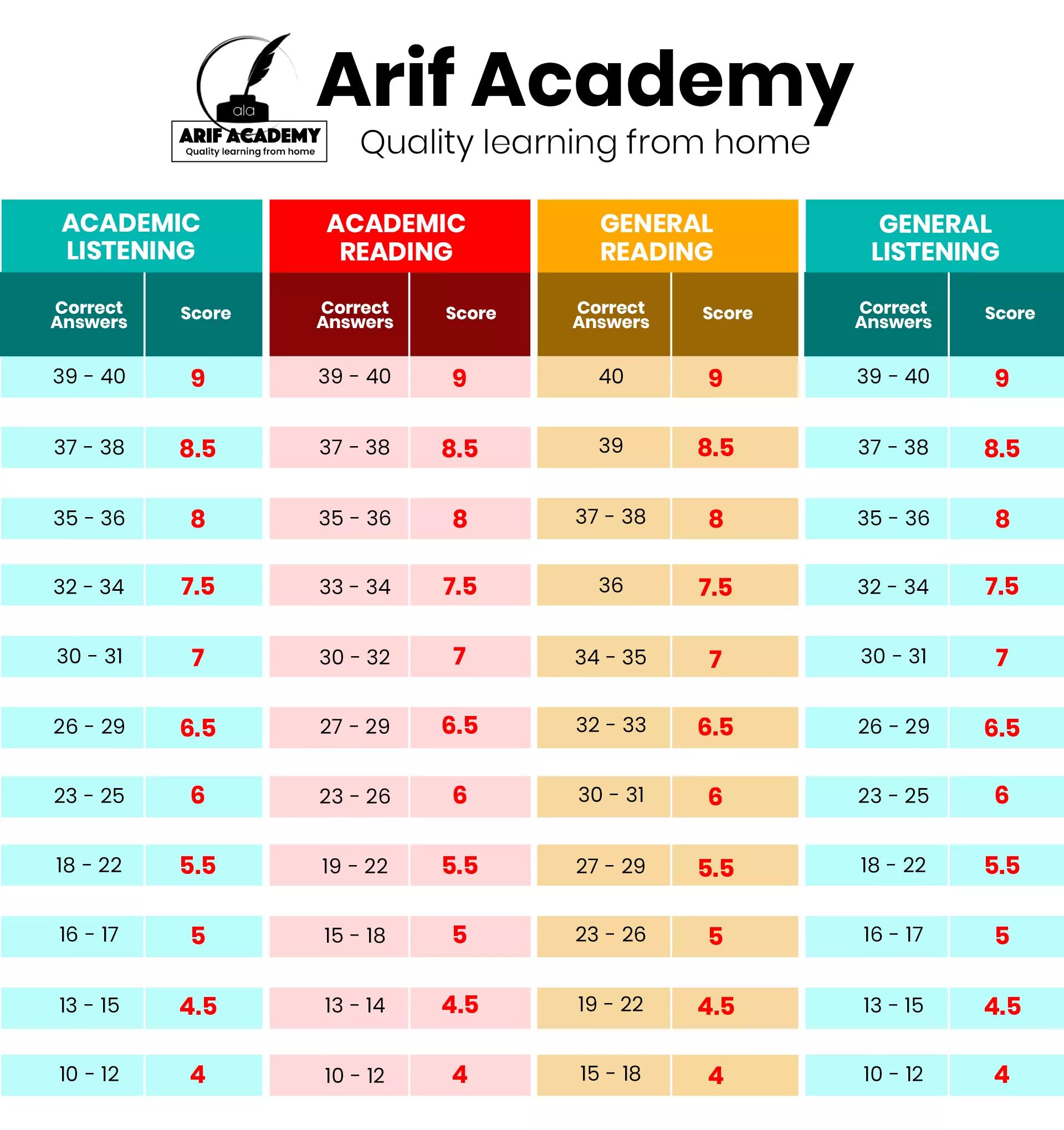
IELTS marking system chart for Listening and Reading
The official IELTS marking system chart for Listening and Reading is shown in the image below.
How to use Arif Academy's IELTS calculator?
Arif Academy's IELTS calculator is a quick and accurate way to estimate your IELTS band scores and overall result. By following a few simple steps, you can calculate your individual and overall IELTS band score, then compare your results with the entry requirements of top universities.
5 steps to use Arif Academy's online IELTS score calculator are listed below.
- Enter your Listening and Reading scores: Start by selecting whether you are taking the Academic or General Training IELTS test. Then enter your correct answers out of 40 for the Listening and Reading sections.
- Get your Writing and Speaking band scores: You can use the AI evaluation or Human evaluation option to get the band scores for your Writing and Speaking.
- Calculate your overall IELTS band score: Input all four module scores and click the Calculate button to generate your overall IELTS band score.
- Check your university eligibility: Compare your result with university IELTS requirements using search and filter options.
- Reset and calculate again: Click the Reset button to clear all inputs and calculate again with different scores.
What is the IELTS Calculator?
IELTS calculator is a customized calculator to estimate the IELTS band scores based on the official IELTS scoring system. It converts your Listening and Reading raw scores (correct answers out of 40) into band scores and then calculates your overall band by averaging the scores from all four modules.This IELTS band score estimator helps students evaluate themselves in advance and plan their preparation journey accordingly. The calculated band scores help students identify which skills need the most of your attention and focus on improving them before the real IELTS exam.
How does the IELTS Calculator work?
The IELTS Calculator converts your Raw scores (correct answers) into respective IELTS bands for Listening and Reading. The overall band score is calculated by averaging the scores from all four modules according to the official IELTS rounding rules.
The calculating system of the IELTS calculator is listed below.
- Convert raw scores: Listening and Reading raw scores (correct answers) are matched with the official IELTS band conversion tables to determine the corresponding band score for each module.
- Average module scores: The individual band scores from Listening, Reading, Writing, and Speaking are averaged to calculate the overall IELTS band score.
- Apply official rounding rules: The average band score is rounded according to the official IELTS rounding rules. Scores ending in .25 are rounded up to .5, while scores ending in .75 are rounded up to the next whole band to determine the final estimated IELTS band score.
What is the IELTS scoring system for Listening and Reading?
The IELTS scoring system for Listening and Reading is a conversion method for determining the band score for the number of correct answers you achieve. The Listening band score conversion is the same for both Academic and General Training tests but The Reading conversion differs because the Academic and General Training Reading tests have different levels of difficulty. By understanding how raw scores are converted into band scores, you can set realistic target scores, monitor your progress, and prepare more effectively for the IELTS exam.
What is the IELTS scoring system for Writing?
The IELTS Writing scoring system evaluates your performance using four assessment criteria: Task Achievement in Task 1, Task Response in Task 2, Coherence and Cohesion, Lexical Resource, and Grammatical Range and Accuracy. Each assessment criterion contributes 25% to the final Writing band score. Task 2 carries 67% of the total marks, and Task 1 carries the remaining 33%.
Task Achievement and Task Response
The IELTS Writing assessment uses Task Achievement for Task 1 and Task Response for Task 2. Task Achievement and Task Response are separate assessment criteria for IELTS Writing Task 1 and Task 2, but both evaluate how effectively the writing fulfills the task requirements.
Writing Task 1 – Task Achievement
The key skills assessed in IELTS Writing Task 1 are listed below.
- Addresses all parts of the task
- Presents a clear overview
- Selects key features
- Supports key features with relevant details
- Uses accurate comparisons where appropriate
Writing Task 2 – Task Response
The key skills assessed in IELTS Writing Task 2 are listed below.
- Addresses every part of the question
- Presents a clear position
- Develops ideas logically
- Supports ideas with relevant examples
- Maintains a consistent argument
Coherence and Cohesion
Coherence and Cohesion assesses how logically ideas are organized and connected throughout the writing.
The key areas evaluated for coherence and cohesion are listed below.
- Organizes ideas logically
- Structures paragraphs effectively<
- Uses linking words naturally
- Connects ideas smoothly
- Maintains overall readability
Lexical Resource
Lexical Resource evaluates the range, accuracy, and appropriateness of vocabulary used in the writing.
The key areas evaluated for lexical resources are listed below.
- Uses a wide vocabulary range
- Chooses appropriate words
- Uses collocations naturally
- Demonstrates spelling accuracy
- Avoids unnecessary repetition
Grammatical Range and Accuracy
Grammatical Range and Accuracy evaluates the variety and correctness of grammatical structures used throughout the writing.
The key areas evaluated for grammatical range and accuracy are listed below.
- Uses a variety of sentence structures
- Demonstrates grammatical accuracy
- Forms complex sentences correctly
- Uses punctuation appropriately
- Maintains grammatical control
What is the IELTS scoring system for Speaking?
The IELTS Speaking scoring system uses four assessment criteria: Fluency and Coherence, Lexical Resource, Grammatical Range and Accuracy, and Pronunciation. Each assessment criterion contributes 25% to final IELTS Speaking band score. The examiner assesses candidates' fluency, vocabulary, grammar, and pronunciation to determine the final IELTS Speaking band score.
The four IELTS Speaking assessment criteria are listed below.
- Fluency and Coherence
- Lexical Resource
- Grammatical Range and Accuracy
- Pronunciation
Fluency and Coherence
Fluency and Coherence evaluates how naturally candidates speak, how well they organize and connect their ideas throughout the conversation.
The key areas evaluated for fluency and coherence are listed below.
- Speaks at a natural pace
- Develops and extends ideas
- Organizes ideas logically
- Uses linking words appropriately
- Maintains the conversation without excessive hesitation
Lexical Resource
Lexical Resource assesses the range, accuracy, and appropriateness of the vocabulary that candidates use during the Speaking test.
The key areas evaluated for lexical resources are listed below.
- Uses a range of vocabulary without repetition
- Chooses words appropriately
- Uses idiomatic language naturally
- Paraphrases when necessary
- Uses vocabulary accurately
Grammatical Range and Accuracy
Grammatical Range and Accuracy evaluates the variety and correctness of the grammatical structures that candidates use while speaking.
The key skills examined for grammatical range and accuracy are listed below.
- Uses a variety of sentence structures
- Demonstrates grammatical accurac
- Maintains grammatical control throughout the test
Pronunciation
Pronunciation assesses how clearly and naturally candidates speak so that their speech can be understood by the examiner.
The key skills examined for pronunciation are listed below.
- Pronounces words clearly
- Uses appropriate word and sentence stress
- Demonstrates natural rhythm and intonation
- Produces individual sounds accurately
 Google