Writing Answer & Correction
Your writing is expertly evaluated—either by certified IELTS examiners or our advanced AI system. Every mistake is clearly highlighted, accurately corrected, and thoughtfully explained, so you gain deeper insight and improve faster with every attempt.
Feature Explore More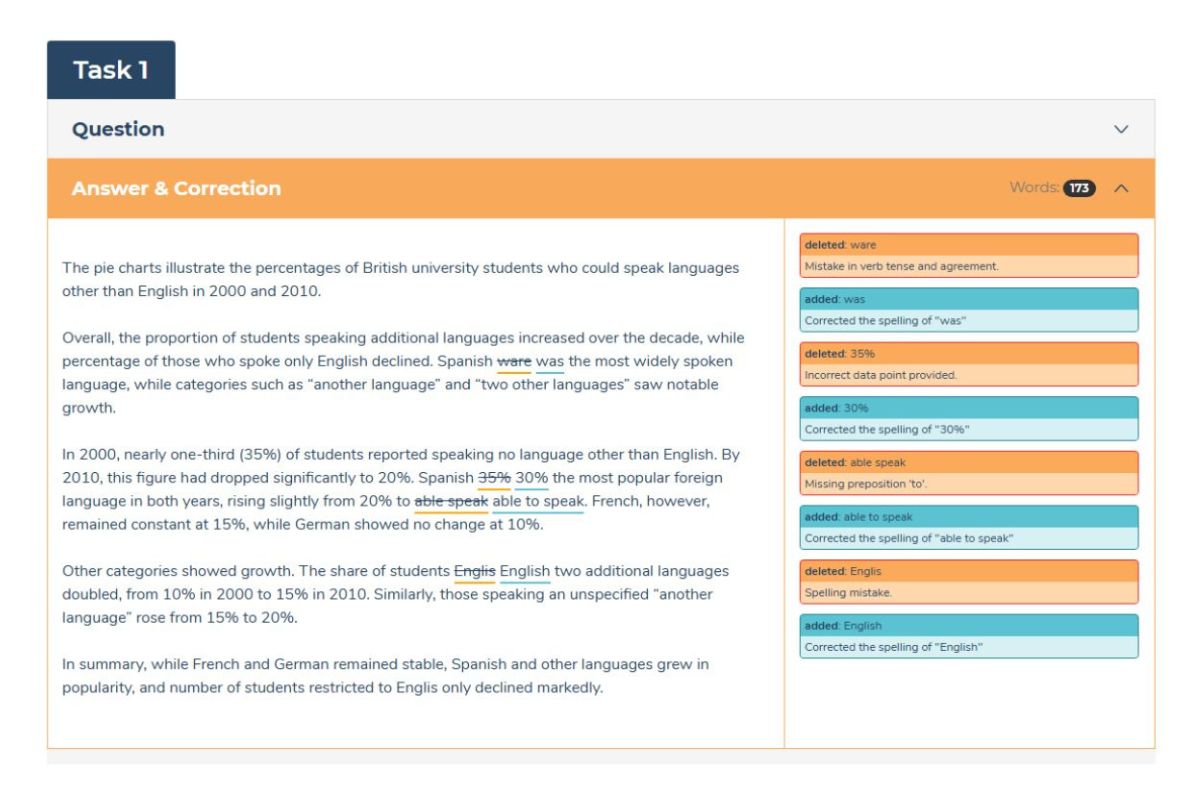
Writing Overall Feedback
Your writing is expertly evaluated—either by certified IELTS examiners or our advanced AI system. Every mistake is clearly highlighted, accurately corrected, and thoughtfully explained, so you gain deeper insight and improve faster with every attempt.
Feature Explore More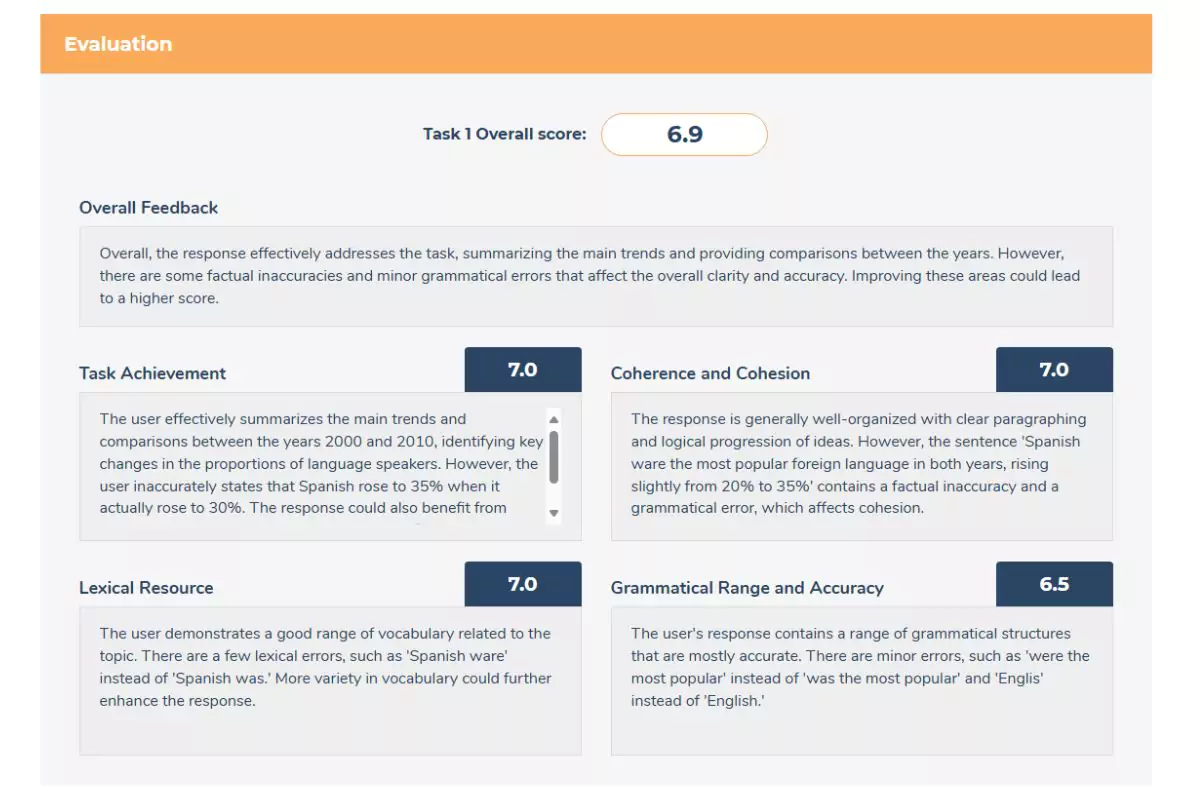
Real-Time Band Score
Get an instant band score as soon as you submit your practice test. Your score is automatically calculated based on your correct answers.
AI/Human Try Writing Eval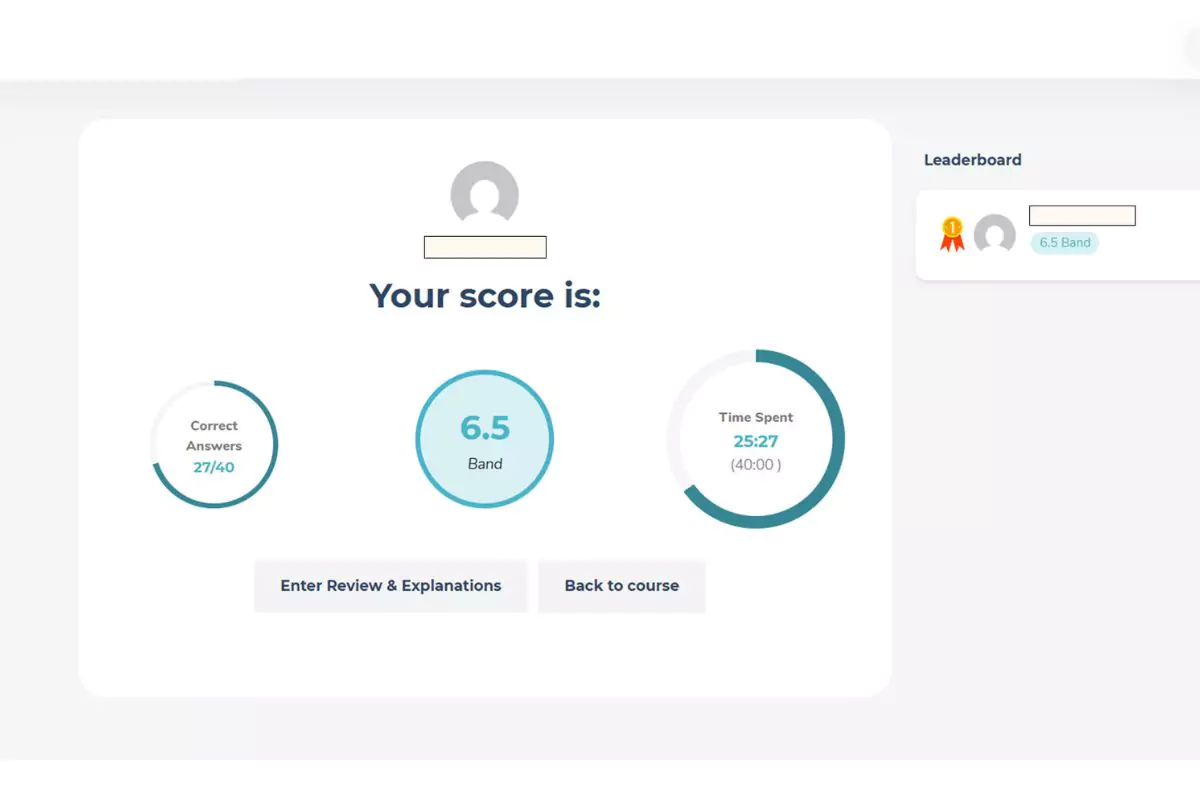
Writing Answer & Correction
Your writing is expertly evaluated—either by certified IELTS examiners or our advanced AI system. Every mistake is clearly highlighted, accurately corrected, and thoughtfully explained, so you gain deeper insight and improve faster with every attempt.
Feature Explore MoreWriting Overall Feedback
Your writing is expertly evaluated—either by certified IELTS examiners or our advanced AI system. Every mistake is clearly highlighted, accurately corrected, and thoughtfully explained, so you gain deeper insight and improve faster with every attempt.
Feature Explore MoreReal-Time Band Score
Get an instant band score as soon as you submit your practice test. Your score is automatically calculated based on your correct answers.
AI/Human Try Writing EvalComputer Based IELTS Writing
Computer based IELTS writing is now one of the most preferred choices for candidates who want a faster, cleaner, and more convenient exam experience. In this format, test takers complete both Task 1 and Task 2 on a computer, which helps with editing, word counting, and time management. Many students choose this option because typing is easier than handwriting, especially when writing longer responses under exam pressure.
To do well in the computer-based test, you need to understand the exam structure, practice common question types, and become familiar with the official scoring criteria. Whether you are looking for IELTS writing task 1 samples, IELTS writing task 2 questions, or the most common IELTS exam writing topics, this guide will help you prepare with confidence.
IELTS Writing Task 2 Band Descriptors
The IELTS writing task 2 band descriptors are the official criteria examiners use to score your essay. These descriptors are divided into four main areas:
Task Response
This measures how well you answer the question, present your ideas, and support your points with relevant examples. A high-scoring essay addresses all parts of the prompt clearly and stays focused throughout.
Coherence and Cohesion
This looks at how logically your ideas are organized and connected. Good paragraphing, smooth transitions, and a clear essay structure are important for a strong score.
Lexical Resource
This refers to your vocabulary. To score well, you should use a range of words accurately and naturally. Avoid repeating the same terms too often.
Grammatical Range and Accuracy
Examiners check your sentence variety and grammar control. Strong candidates use simple and complex sentences correctly, with fewer grammar mistakes. Understanding the IELTS writing task 2 band descriptors is essential because they tell you exactly what examiners want to see. If your goal is Band 7 or higher, you must go beyond basic writing and show clear development, strong vocabulary, and accurate grammar.
IELTS Writing Subjects
IELTS writing subjects usually cover real-life social, educational, economic, environmental, and technological issues. These subjects are designed to test your ability to express opinions, discuss problems, compare ideas, and present solutions in formal English.
Common IELTS writing subjects include:
- Education
- Environment
- Health
- Technology
- Crime
- Society
- Work and business
- Transportation
- Globalization
The best way to prepare is to practice writing about a wide range of IELTS writing subjects so you can build ideas, vocabulary, and confidence before the exam.
IELTS Exam Writing Topics
IELTS exam writing topics often reflect current issues that are relevant worldwide. In Task 2, you may be asked to discuss whether you agree or disagree, examine both views, explain advantages and disadvantages, or analyze a problem and suggest solutions.
Popular IELTS exam writing topics include the impact of social media, online education, public transportation, healthy lifestyles, climate change, and the role of governments in society. These topics require formal writing, logical reasoning, and clear examples.
Success in the exam depends not only on English skills but also on your ability to understand the question quickly and respond with a well-organized essay.
| Topic Area | Possible Focus |
|---|---|
| Technology | Social media, automation, digital communication, online learning |
| Health | Public health, exercise, diet, government responsibility |
| Transport | Public transportation, traffic congestion, urban planning |
| Environment | Climate change, pollution, recycling, sustainability |
| Society | Family, public behavior, education, crime, social change |
IELTS Writing Task Two Topics
IELTS writing task two topics are especially important because Task 2 carries more weight in your overall writing score. These topics are broad and are designed to test your ability to write a full academic essay in around 40 minutes.
Common Task 2 Topics
- Should university education be free?
- Is technology making people less social?
- Are the benefits of tourism greater than its drawbacks?
- Should governments invest more in public health?
- Is advertising influencing children negatively?
IELTS Writing Task 1 Samples
IELTS writing task 1 samples are very useful for understanding the structure and tone required in the exam. In the Academic module, Task 1 usually asks you to describe charts, graphs, tables, maps, or processes. In the General Training module, Task 1 involves writing a letter.
By reading sample answers, you can learn how to:
- Write a clear introduction
- Identify key features
- Compare important data
- Avoid unnecessary details
- Use formal and accurate language
A good Academic Task 1 answer usually includes an introduction, an overview, and two detailed body paragraphs. A good General Training letter includes a clear purpose, appropriate tone, and complete coverage of all bullet points.
Using quality IELTS writing task 1 samples during your practice can help improve your structure, vocabulary, and confidence.
IELTS Writing Task 2 Questions
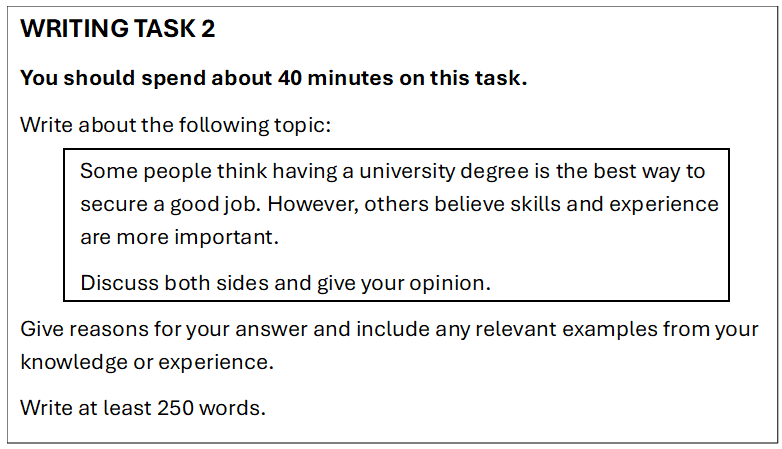
IELTS writing task 2 questions come in several common formats. Knowing these formats can make your preparation much easier because each one requires a slightly different approach.
The most common IELTS writing task 2 questions are:
Agree or Disagree
Present a clear position from the beginning and support it consistently.
Discuss Both Views
Explain both sides fairly before giving your own opinion.
Advantages and Disadvantages
Balance both sides clearly and evaluate the overall impact.
Problem and Solution
Identify real causes and match them with practical solutions.
Direct / Two-Part Question
Answer each question directly and organize your essay carefully.
Each question type requires careful planning. For example, an agree or disagree essay should present a clear position from the beginning, while a discuss both views essay should explain both sides fairly before giving your own opinion.
The more IELTS writing task 2 questions you practice, the better you will become at recognizing patterns and organizing your ideas quickly.
IELTS Writing Task 2 Subjects
IELTS writing task 2 subjects are usually linked to real-world issues that students and professionals can relate to. These subjects are not random. They are selected to test your ability to think critically and write in a balanced, formal style.
Common IELTS writing task 2 subjects include:
- The role of parents and schools
- Environmental protection
- Public services
- Media influence
- Employment trends
- Modern lifestyles
- Crime prevention
- Urban development
A strong vocabulary bank for these IELTS writing task 2 subjects can give you a major advantage in the exam.
IELTS Writing Task 2 Subjects
IELTS writing task 2 topics are widely searched by students because they form the core of serious exam preparation. When you practice different essay topics, you improve idea generation, paragraph development, and time control.
Here are a few examples of IELTS writing task 2 topics:
- Some people believe children should begin learning a foreign language at primary school. Do the advantages outweigh the disadvantages?
- In many countries, people are living longer. How does this affect individuals and society?
- Some think that governments should spend more money on roads than public transport. To what extent do you agree or disagree?
To improve with IELTS writing task 2 topics, write regularly, review your mistakes, and compare your work with high-band model essays.
IELTS Writing Task 2 Cause and Solution Questions
IELTS writing task 2 cause and solution questions are very common in the exam. These questions ask you to explain why a problem happens and what can be done to solve it.
Simple Structure for This Essay Type
- Introduction: Paraphrase the question and mention that you will discuss causes and solutions.
- Body Paragraph 1: Explain the main causes clearly. For example, growing populations, poor public transport, or increasing car ownership.
- Body Paragraph 2: Present practical solutions. For example, better transport systems, road planning, higher parking fees, or remote working options.
- Conclusion: Summarize the key causes and solutions in a concise way.
To score well, make sure your solutions directly match the causes you mentioned. Strong linking between ideas is very important.
Best Strategy for IELTS Writing Task Two Questions
IELTS writing task two questions are another way students refer to Task 2 essay prompts. These questions test your ability to write a clear and convincing argument in formal English within 250 words or more.
The best strategy for answering IELTS writing task two questions is to:
- Read the question carefully
- Identify the essay type
- Spend a few minutes planning
- Write a direct introduction
- Develop one clear main idea per paragraph
- Use examples naturally
- Leave time to check grammar and spelling
FAQs About IELTS Writing
1. What is the difference between Task 1 and Task 2 in IELTS writing?
In Task 1, you are asked to describe or summarize data presented in a graph, table, or diagram.
In Task 2, you need to write an essay discussing a topic or presenting arguments.
2. How can I improve my score in IELTS Writing?
To improve your score, focus on writing clear, well-structured essays, use a range of vocabulary, and minimize grammar mistakes. Practice regularly and familiarize yourself with common IELTS writing topics.
3. What are some common mistakes to avoid in IELTS writing?
Avoid common mistakes like:
- Misunderstanding the question
- Writing too much or too little
- Spend a few minutes planning
- Repeating words or phrases
- Not organizing your ideas logically
4. How long should my IELTS writing Task 2 essay be?
Your Task 2 essay should be at least 250 words long. Focus on quality and clarity rather than word count.
Final Thoughts
Computer based IELTS writing can be a great choice for candidates who are comfortable typing and want a more flexible writing experience. It offers clear advantages such as easy editing, automatic word count, and better readability. However, success still depends on preparation, strategy, and regular practice.
If you want a higher score, study the IELTS writing task 2 band descriptors, review IELTS writing task 1 samples, and practice as many IELTS writing task 2 questions and IELTS writing task 2 topics as possible. The more familiar you become with IELTS writing subjects, IELTS exam writing topics, and writing topics of IELTS, the more confident and prepared you will feel on test day.
 Google