Angkor Wat
Paragraph 1
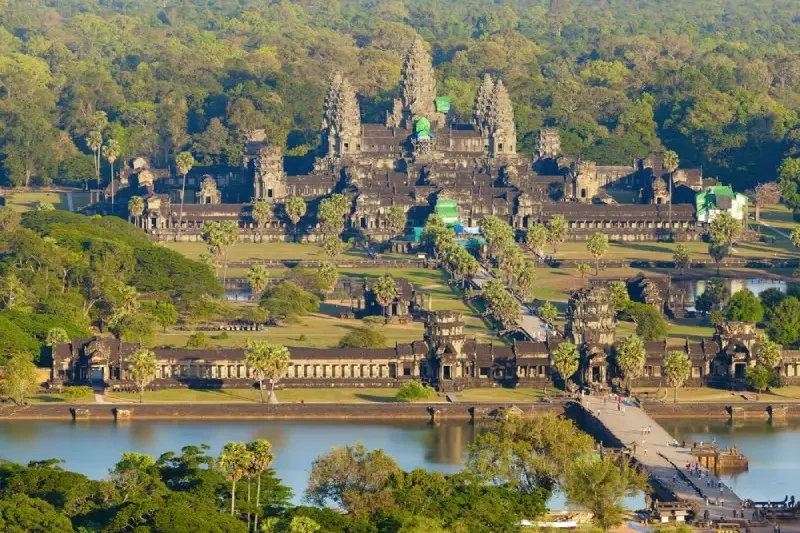
Angkor Wat is simply unique, a stunning blend of spirituality, and symmetry, an enduring example of man's devotion to his gods. Relish the very first approach, as that spine-tickling moment when you emerge on the inner causeway will rarely be felt again. It is the largest and undoubtedly the most breathtaking of the monuments at Angkor, and is widely believed to be the largest religious structure in the world. It is also the best-preserved temple at Angkor, as it was never abandoned to the elements, and repeat visits are rewarded with previously unnoticed details. It was probably built as a funerary temple for Suryavarman II to honor Vishnu, the Hindu deity with whom the king identified.
Paragraph 2
There is much about Angkor Wat that is unique among the temples of Angkor. The most significant point is that the temple is oriented towards the west. This is symbolically the removal of death, which once led a large number of scholars to conclude that Angkor Wat must have existed primarily as a tomb. This idea was supported by the fact that the magnificent bas-reliefs of the temple were designed to be viewed in an anticlockwise direction, a practice that has precedents in ancient Hindu funerary rites. Vishnu, however, is also frequentlyly associated with the west, and it is now commonly accepted that Angkor Wat most likely served both as a temple and a mausoleum for Suryavarman II.
Paragraph 3
Angkor Wat is famous for its beguiling apsara (heavenly nymphs). There are more than 3,000 carved into the walls of the temple, each of them unique, and there are more than 30 different hairstyles for budding stylists to check out. Many of these exquisite apsara were damaged during Indian efforts to clean the temples with chemicals during the 1980s, the ultimate bad acid trip, but they are now being restored by the teams of the German Apsara Conservation Project (GACP). The organization operates a small information booth in the northwest corner of Angkor Wat, where beautiful black-and-white postcards and images of Angkor are available.
Symbolism
Visitors to Angkor Wat are struck by its imposing grandeur and, at close quarters, its fascinating decorative flourishes and extensive bas-reliefs. However, a scholar at the time of its construction would have revelled in its multilayered levels of meaning in much the same way as a contemporary literary scholar might delight in James Joyce's “Ulysses”.
David Chandler, drawing on the research of Eleanor Moron, points out in his book, “History of Cambodia”, that the spatial dimensions of Angkor Wat parallel the lengths of the four ages (Yuga) of classical Hindu thought. Thus, the visitor to Angkor Wat who walks the causeway to the main entrance and through the courtyards to the final main tower, while once containing a statue of Vishnu, is metaphorically traveling back to the creation of the universe.
Architectural Layout
Angkor Wat is surrounded by a moat, 190m wide, which forms a giant rectangle measuring 1.5km by 1.3km. From the west, a sandstone causeway crosses the moat; the holes in the paving stones held wooden pegs that were used to lift and position the stones during construction. The pegs were then sawn off and have since rotted away. The sandstone blocks from which Angkor Wat was built were quarried more than 50km away (from the district of Svay Leu at the eastern foot of Phnom Kulen) and floated down the Stung Siem Reap (Siem Reap River) on rafts. The logistics of such an operation are mind-blowing, consuming the labor of thousands – an unbelievable feat given the lack of cranes and trucks that we take for growing in contemporary construction projects.
The rectangular outer wall, which measures 1,025m by 800m, has a gate on each side, but the main entrance, a 235m-wide porch richly decorated with carvings and sculptures, is on the western si de. In the gate tower, to the right as you approach, is a statue of Vishnu, 3.25m in height and hewn from a single block of sandstone. Vishnu's eight arms hold a mace, a spear, a disk, anachonch and other items. You may even see locks of hair lying about. These are a n offering by both young women and men preparing to get married or by people who seek to give thanks for their good fortune.
The central temple complex consists of three storeys, each made of laterite, which enclose a square surrounded by intricately interlinked galleries. The Gallery of a Thousand Buddhas used to house hundreds of Buddha images before the war, but many of these were removed or stolen, leaving the broken remnants we see today.
The corners of the second and third storeys are marked by towers, each topped with pointed cupolas (domed structures). Rising 31m above the third level, and 55m above the ground, is the central tower, which gives the whole ensemble its sublime unity.
Once at the central tower, the pilgrimage is complete: soak up the breeze, take in the views and then find a quiet corner in which to contemplate the symmetry and symbolism of this Everest of temples.
Part 1
Questions 1-4
Answer the questions below. Choose NO MORE THAN THREE WORDS from the passage for each answer.
In which direction does Angkor Wat face? 1
What was originally in the main tower? 2
What happened to the wooden pegs used to construct the causeway? 3
What do you finally do when your journey through Angkor Wat is over? 4
Questions 5-13
Complete the sentences below. Choose NO MORE THAN THREE WORDS from the passage for each answer.
Angkor Wat was built inside a large rectangular 5
and can be reached by walking across a 6
The blocks used to build it were first 7
and then transported on rafts.
The ability to do this without 8
is hard to believe.
Angkor Wat is further 9
than any other building to be seen here.
The 10
are responsible for restoring many of the carvings.
The temples of Angkor are a representation of the 11
The statue of Vishnu was carved from 12
The central tower marks the end of your 13